
Painting midsoles without cracks
Step by step, from stripping to finish
Painting midsoles: the short version
A painted midsole stays intact when you get three things right: remove the old layer, choose paint that flexes, and apply that paint in many thin coats with drying time in between. Degrease and strip the sole, tape off the edges, build up the colour coat by coat and only choose a finisher for matte or gloss at the very end. Coats that are too thick and rushing the job are the most common causes of cracking.
What do you need?
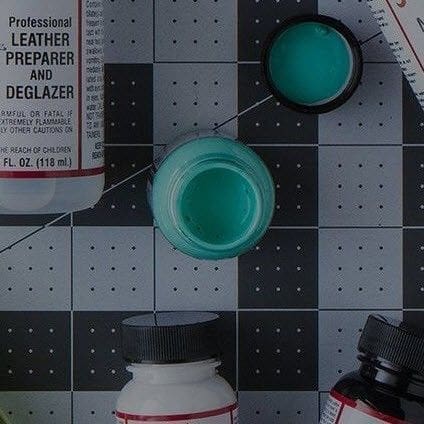
- Preparation: Essential Deglazer to remove grease, dirt and the factory finish, plus cotton pads and cotton swabs.
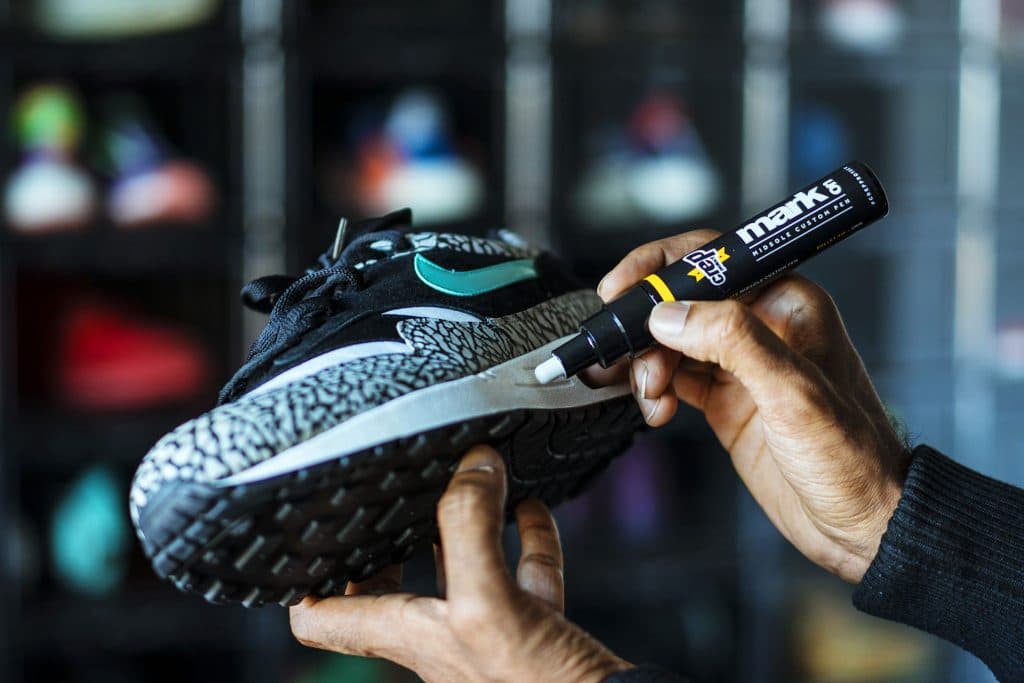
- Paint: paint that is suitable for midsoles, such as the SneakersER Premium paint for leather and midsoles or a midsole paint marker. You will find the full range in midsole paint.
- Taping off: masking tape for painting your sneakers in 25 or 50 mm, or Premium Masking Tape for crisp lines.
- Brushes: an Essential starter brush set for surfaces and edges; for small details a fine brush from brushes and other supplies.
- Useful: a mixing pot for paint so you do not work straight from the bottle, and a detail knife for customizing for loose paint flakes.
- Finishing (optional): Angelus Brand Duller Gloss Reducer for a more matte look, or a finisher (see step 6).
- Protection: gloves and a well ventilated room.
Clean first: paint does not stick to dirt or grease. So clean the shoe thoroughly first and let it dry completely before you start.
Step 1: check what is on your midsole now
The right preparation depends on the layer that is already there. Hold the shoe under a good lamp, then look and feel:
| What you see and feel | What it usually is | Approach |
|---|---|---|
| Smooth and shiny, no cracks | A sealed factory finish or lacquer | Deglazer in calm rounds; this takes patience |
| Paint with cracks or flakes coming loose | An old paint layer that has lost its grip | First scrape off the loose parts carefully, then deglazer for what is left |
| Rough or textured, paint sits in the grooves | A thin colour layer on a porous sole | Deglazer on a cotton swab; a light shadow may stay |
| Clear window or air unit | Plastic that can turn dull from solvent | No deglazer or acetone directly on the clear part (see step 2) |
Not sure? Test from mild to strong
- Put a little deglazer on a cotton swab and rub a spot nobody sees, for example on the inside near the heel. If colour comes off on the swab, this is your method.
- If nothing comes off, try on another hidden spot whether loose paint can be scraped off with the back of a knife, held flat.
- Does neither work, or do you have to press hard? Then stop. Pushing on damages the sole faster than it helps. Feel free to send us a photo through customer service.
Step 2: strip the midsole without damaging it
- Protect yourself. Put on gloves and work near an open window.
- Little liquid. Wet a cotton pad with Essential Deglazer and then squeeze it out well. A dripping pad runs down the sole onto the upper, even under tape.
- Small sections. Work section by section around the sole, with light pressure. Keep turning to a clean side of the pad.
- Know when you are done. The sole no longer feels smooth but slightly grippy, and hardly any colour comes off. A light discolouration or shadow may stay. If you keep going, the product soaks into the sole and it can turn soft or porous.
- Scrape off loose paint. Keep the knife flat, cutting edge away from you, and scrape with short strokes in one direction. You only remove paint that is already loose; you do not cut into the sole.
- Light sanding (optional). A light sanding with fine sandpaper can improve adhesion. Wipe away the dust afterwards with a pad and some deglazer.
Older shoes: foam gets softer over the years and can start to crumble. If the sole feels soft or brittle, work extra carefully or skip the stripping.
Air units and clear parts
Solvent can make clear plastic dull or milky, and you cannot get it clear again. Tape off the window and work the edge around it with an almost dry cotton swab.
Step 3: tape off
- Outsole: tape off the edge where the midsole meets the outsole with masking tape. Lay the tape tight along the line and press the edge down well with your fingernail.
- Leather upper: regular masking tape works here too.
- Suede or nubuck upper: strong tape can pull out fibres or leave glue behind. Use a less sticky tape, or work without tape using a fine brush and a steady hand.
- Curves: you can lay the tape in short pieces, or in one long strip that you then trim along the edge with a knife. Whatever you prefer works.
Step 4: paint in thin coats
Which paint do you choose?
| Product | When it is useful | According to the manufacturer |
|---|---|---|
| SneakersER Premium paint for leather and midsoles | A whole midsole or large surfaces, with a brush | Can be used straight from the bottle on the midsole, elastic and water resistant, slightly matte |
| SneakersER Pearl paint for leather and midsoles | Accents with a pearl sheen | For leather and midsoles |
| SneakersER midsole paint markers (in midsole paint) | Touching up, edges, small surfaces, if you would rather not use a brush | Flexible formula, suitable for small repairs and a whole midsole |
| Alpha 6 Alphaflex (in textile paint) | If you want the same colour on leather or fabric too | Flexible and water resistant, ready to use on leather and textile |
| Angelus standard leather paint | If you are looking for a colour that the midsole range does not have | Flexible and water resistant, made for leather |
Prefer a paint pen? In how to use the SneakersER paint pens you can read how to prime and use them.
How to apply the coats
- Shake or stir the paint well and pour a little into a mixing pot. Dip only the tip of your brush.
- Start at the back by the heel and work around the shoe in one direction. Spread the paint out as far as possible before you pick up more.
- Accept an ugly first coat. Can you still see the old colour through it? Then you are doing it right. A first coat that covers straight away is almost always too thick.
- Remove lint and hairs right away while the paint is wet, with a clean finger or the tip of the brush, and smooth the spot afterwards.
- Let each coat dry with air, not heat. A fan or a hair dryer on the cold setting helps. We advise against warm air or a heat gun for midsole and leather paint; let the paint dry calmly in the air instead. Textile paint is different: according to the manufacturer you set it with heat, following the instructions on the product.
- Repeat until the colour is even and opaque.
How many coats you need depends on the paint, the colour and the surface. For the drying time per coat, follow the manufacturer's instructions on the product.
Airbrush: that works too. Use the same thin coats and drying time. Look in airbrush paint for paint made for it.
Step 5: two or more colours
- Light first, dark after. Paint the lightest colour first. If you go over the border into the dark part, no problem: you will cover that later.
- Let the first colour cure well before you put tape on it. Paint that is too fresh lifts off with the tape.
- Lay narrow tape in one strip. One long strip gives a calm, continuous line; separate pieces give kinks more easily. In a curve, lift the tape briefly and lay it down again. Then press it down firmly.
- Seal the tape edge with the first colour. Put a thin coat of the light colour over the edge of the tape and let it dry. If paint creeps under the tape, it is the light colour and you will not see it.
- Paint the second colour the same way as the first: thin coats, drying time in between.
- Pull the tape off slowly and at an angle. If paint comes with it, the adhesion was not good enough or the paint was too thick. Go back to steps 2 and 4 for that section.
A colour fade is made without tape: blend the two colours into each other wet on wet.
More ideas for contrast colours in colour blocking midsoles.
Step 6: finish in matte, satin or gloss
A finisher mainly decides how the midsole looks. It does not make a poorly prepared or thickly painted sole any stronger. Once the base is right, the finisher lets you choose the end result.
- Matte, like from the factory: mix a little Angelus Brand Duller Gloss Reducer into your paint. Use it sparingly and stick to the manufacturer's dosage; more is not better.
- Gloss: according to the manufacturer, the Liquid Kicks Top Coats leather sealer gloss finish is a scratch resistant, waterproof top coat for leather, vinyl and canvas, among others. The manufacturer does not mention midsoles separately, so try it on a small, hidden spot first.
- Apply a finisher just like paint in thin coats, on paint that is completely dry.
The difference between matte and gloss is explained in matte or gloss: the effect of Duller and finisher; the order from preparation to finish in preparation and finishing.
Final check
- Look at the sole under a lamp from every side. Touch up light spots with a fine brush.
- Remove the tape.
- Let the shoes cure completely before you wear them. How long that takes is in the manufacturer's instructions on the product.
From white to black, or lighter instead
- Making a white sole black: that is the easy direction. Dark paint covers quickly, although thin coats are still needed.
- Making a dark sole lighter: that takes more coats. Start with a grey base coat, for example Angelus Brand Standard Leather Paint Gray; a light colour covers faster on that than on black.
- Yellowed sole: paint makes the sole even again. More about that in painting yellowed midsoles.
- Clear sole: paint makes a clear sole opaque. If you want it to stay see-through but get a colour, you need a transparent dye; we do not sell that.
Holes, pores or a damaged sole
Some midsoles have small holes or pores that were hidden under a thick layer of paint at the factory. If you strip that layer and paint thinly, they become visible again. Painting thicker does not solve that: that is exactly the layer that cracks later. Fill pores before painting with a flexible filler. Not sure whether your sole can still be saved? Send us a photo through customer service.
Common mistakes and how to fix them
| What you see | Likely cause | Fix |
|---|---|---|
| Cracks where the shoe flexes | Coats too thick, too little drying time or not stripped | Strip that section again and build up in thin coats |
| Paint comes loose after a few wears | Grease or factory finish still present | Strip until the sole feels grippy, then paint again |
| Paint comes off with the tape | Tape applied too early, or weak adhesion | Let it cure longer; with weak adhesion go back to step 2 |
| Patchy colour | Coats too thick or not enough coats yet | One or more extra thin coats, spread out well |
| Dull, milky air unit | Solvent on the clear part | Prevent it: tape off and work almost dry |
| Colour creeps under the tape | Tape edge not sealed | Seal the edge first with the lower colour (step 5) |
Further reading


Finish and protect
Matte or gloss: choose your finish only once the paint is completely dry. Below you will find what is available now.


Painting midsoles
Frequently asked questions
How do you paint midsoles without them cracking?
First remove the old layer until the sole feels slightly grippy, use paint that is suitable for midsoles and apply it in many thin coats with drying time in between. Dry with air, not heat. The full step-by-step plan is above.
Can you paint a rubber sole?
Yes. Strip or degrease the rubber sole first so the paint can grip, and use paint that flexes. A foam or rubber midsole needs the same approach: thin coats and patience. See our midsole paint.
Can you paint a white sole black?
Yes, that is the easiest direction: dark paint covers quickly. Still work in thin coats, otherwise the paint cracks where the sole flexes.
Can you paint a dark sole white or lighter?
Yes, but it takes more coats. Start with a grey base coat, for example Angelus Brand Standard Leather Paint Gray; a light colour covers faster on that than directly on a dark surface.
Which paint do you use for midsoles?
Paint that is made to flex. According to the manufacturer, the SneakersER Premium paint for leather and midsoles can be used straight from the bottle on the midsole. Alpha 6 Alphaflex and Angelus leather paint are also used for midsoles. All midsole paint.
Paint pen or paint from a bottle: which works better?
A midsole paint marker is handy for edges, touching up and if you do not like working with a brush. With paint from a bottle and a brush you cover larger surfaces faster and more evenly. Also read how to use the SneakersER paint pens.
Can you colour a sole with a regular permanent marker?
A regular permanent marker is not made for a sole that flexes and wears; the colour can smudge or rub off. Use a midsole paint marker or paint that is suitable for midsoles instead.
How do you remove paint from places where it does not belong?
Wipe off wet paint straight away. On the sole, carefully remove dried mistakes with a cotton swab and a little Essential Deglazer; work in small areas. If the paint is on the leather upper, read painting leather sneakers with leather paint.
How long does midsole paint take to dry?
That depends on the paint, the thickness of the coat and the temperature. Let each coat dry before you apply the next and follow the drying time in the manufacturer's instructions on the product. You can speed up drying with a fan or a hair dryer on the cold setting, not with warm air.